A broader way to think about money, time, and the capacity to live well.
Read time: 5 minutes
Early in my career in finance, I met people who earned extraordinary incomes yet constantly felt financial pressure. At the same time, I also met people with far more modest incomes who gradually built stability and freedom.
On paper, the first group looked wealthier.
In practice, the second group often lived better.
That contrast forced me to rethink a simple assumption many of us grow up with: that wealth is mostly about money.
Many people measure wealth by income, investments, or possessions.
- A higher salary.
- A larger portfolio.
- A bigger house.
These things matter. Money creates options and security.
But over time, I realized that money is only one form of margin.
Wealth also appears in two other forms: time and energy.
Time determines how much freedom we have to shape our lives. Energy determines how well we can use that time.
Without time, even financial success can feel restrictive. Without energy, even financial freedom can become difficult to use.
One way to think about this is through a simple triangle of wealth.
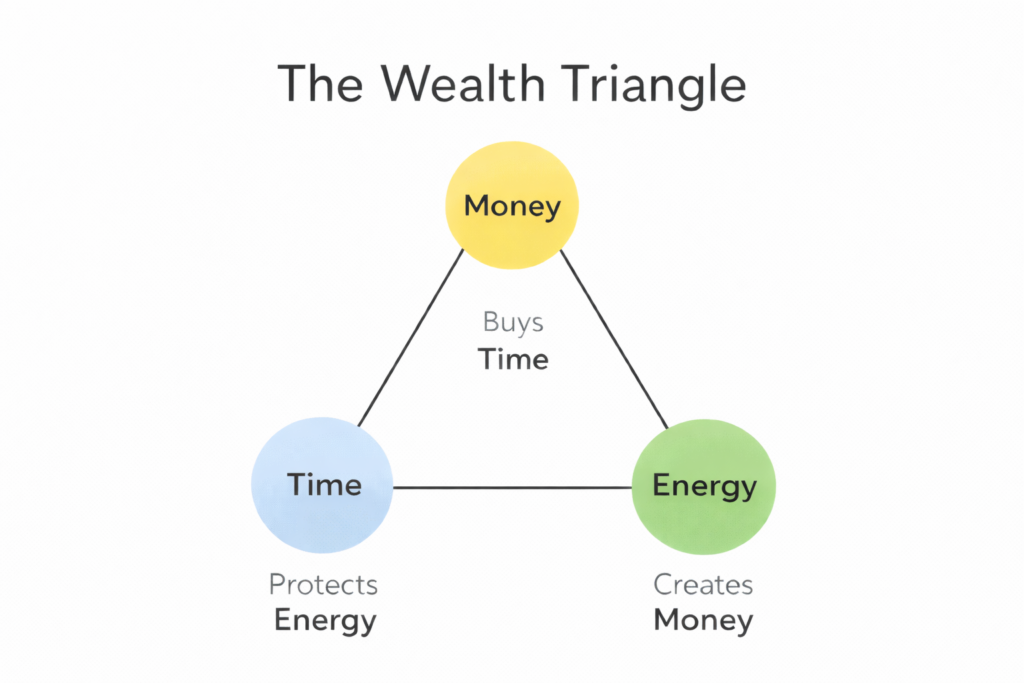
Each corner represents a different form of wealth.
Money expands opportunities. Time expands freedom. Energy determines how well we can use both.
Financial resources may create options, but without time, those options can feel restrictive. Without energy, even financial freedom can become difficult to use.
Two people may have the same net worth.
One is exhausted, stressed, and constantly overwhelmed. The other has time, health, and emotional stability.
On paper, their wealth may look similar. In reality, their lives are very different.
When money, time, and energy reinforce each other, wealth becomes much more powerful.
Financial stability reduces stress. Reduced stress improves emotional stability. Emotional stability improves decision-making.
Better decisions then improve financial outcomes again.
Over time, this creates a reinforcing cycle.
Small advantages compound. Stability leads to clarity. Clarity leads to better choices.
These ideas eventually led me to organize my thinking around a framework I call the Seven Pillars of Wealth.
The pillars are designed to build financial margin while also protecting time and energy so that progress can continue over long periods.
- Pay Yourself First
- Prioritize Your Spending
- Power Your Savings
- Protect Your Savings
- Position Your Housing Wisely
- Prepare for the Future
- Propel Your Earning Power
Each pillar strengthens financial security. Together they create something deeper: the conditions for a calmer and more stable life.
Because in the end, wealth is not only about the resources we accumulate. It is about the capacity we bring to each day.
If these ideas resonate with you, you can join the newsletter to receive future essays on wealth, decision making, and long term compounding.