Some things have to be protected before their value becomes clear.
Read time: 5 minutes
Over Labor Day weekend, my family took a short trip to Kansas City. My wife wanted to visit the Nelson-Atkins Museum of Art and see its Chinese art collection, and that was probably the biggest reason I wanted us to make the trip. It mattered to her, and because I love her, it mattered to me.
I hadn’t expected to find such a deep collection of Chinese art there. We saw paintings and ceramics spanning centuries, including restrained Song dynasty works whose value isn’t immediately obvious from decoration alone. A simple pale-green vase could hold nearly a thousand years of history.
I also wanted our four-year-old daughter to see more of the world outside her normal routine. We took her to Science City, where she moved from one exhibit to another, completely absorbed in whatever was in front of her.
Somewhere during the trip, I started thinking about how difficult it is to measure the value of experiences like these. A weekend away costs money and time, and there is always something else I could be doing. But spending time with my wife doing something important to her, or giving my daughter another small window into the world, doesn’t fit neatly into that calculation.
Some of the things that matter most are difficult to value precisely because their return isn’t immediately visible.
A decision before you know the outcome
I recently came across the story of Dolly Parton and I Will Always Love You. Elvis Presley wanted to record the song, an opportunity Dolly badly wanted, but his manager, Colonel Tom Parker, required her to give up half of the publishing rights. She said no.
What stayed with me wasn’t how valuable the song eventually became. It was that she had to decide before she knew.
She couldn’t look ahead and see Whitney Houston recording the song years later or know what those publishing rights would eventually be worth. All she could see was what she was being offered and what she was being asked to give up.
That’s what makes decisions like this difficult. The opportunity in front of us is usually concrete, while what we’re protecting often isn’t. A famous artist recording your song is concrete; future ownership is uncertain.
The things easiest to measure aren’t always the things most worth protecting.
What are we giving up?
I’ve spent much of my career thinking about decisions in terms of trade-offs. What am I getting? What am I giving up? What could go wrong?
Those questions are useful, but I’m beginning to think there’s another one worth asking: How much conviction do I have in the thing I’m being asked to give away?
Sometimes that’s ownership. Sometimes it’s money, independence, or the ability to make a different choice later. And sometimes it’s time.
Relationships work this way too. I went to the museum largely because my wife wanted to go. Not everything we do together needs to maximize our own preferences; sometimes the value comes from making room for something that matters to the other person.
Parenthood may require even more faith in things we can’t measure. Part of why I wanted to take the trip was to give my daughter more exposure to the world while she’s still forming her understanding of it. I don’t know whether seeing Chinese paintings, exploring Science City, or traveling somewhere unfamiliar will matter to her years from now.
I don’t need to know.
As parents, we make many investments whose returns we may never be able to measure. We expose our children to places, books, people, ideas, and experiences because we believe some of them will become part of how they see the world.
Some value only becomes visible later
I’ve been thinking again about those Song dynasty works at the Nelson-Atkins. Nearly a thousand years later, we can stand in a museum and recognize their historical and artistic value. Time has made that value easier for us to see.
Most decisions don’t give us that advantage. We have to make them while the future is still uncertain.
I don’t know what my daughter will remember about Kansas City. Maybe she’ll remember Science City, the museum, or something completely different. Maybe years from now she won’t remember much of the trip at all.
I’m realizing that isn’t really the point. Not everything valuable needs to produce a future memory, a financial return, or some other result we can point to later. Sometimes the value is simply that we chose to be there while the opportunity existed.
That’s also what stays with me about Dolly Parton’s decision. In hindsight, keeping the publishing rights looks brilliant, but hindsight makes difficult decisions look much easier than they were. She didn’t know what the song would eventually be worth. She just knew she wasn’t willing to give half of it away.
Maybe some of the most important decisions in life work this way. We don’t get to know the future value before deciding what to protect. We look at what we’re getting, look carefully at what we’re giving up, and decide what deserves our conviction.
The Kansas City trip reminded me that this applies to more than money or ownership. It applies to the time we make for the people we love and the experiences we choose to give them, even when we can’t know what those experiences will eventually become.
Sometimes we protect something not because we know what it will eventually be worth, but because we’ve decided it’s worth protecting now.
P.S. What’s something in your life you’ve chosen to protect even though you couldn’t measure what it would eventually be worth? Just hit reply. I’d be interested to hear about it.
Explore More
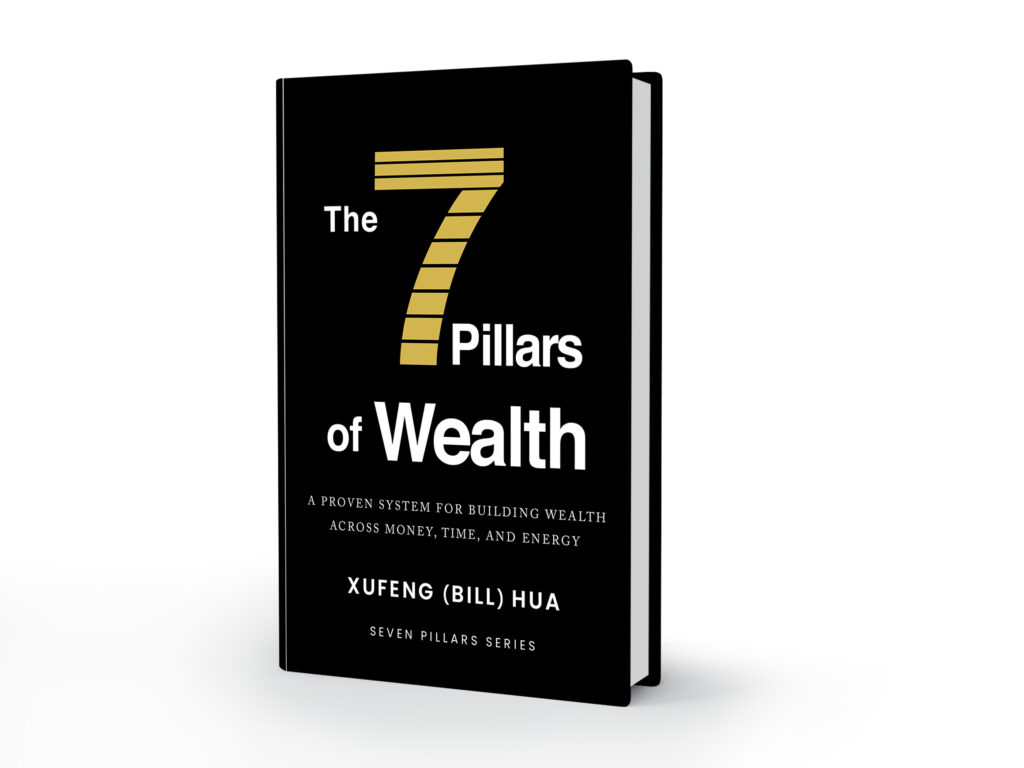
📖 What readers are saying about The 7 Pillars of Wealth:
What readers are saying about The 7 Pillars of Wealth:
“That perspective is crucial for long-term wealth building and made me rethink how I allocate my own resources.”
— Kai, Amazon reader
Learn more about The 7 Pillars of Wealth: http://amzn.to/4tTl5gL.
📝 Take the free 5-Minute Money, Time & Energy Checkup: https://xufenghua.com/checkup/
🌐 Explore more essays and resources: https://xufenghua.com
New here? Subscribe to Compound Emotion, my weekly newsletter about money, time, energy, and the decisions that compound over time.
– Bill