Why lasting wealth rarely comes from a single tactic.
Read time: 3.5 minutes
A quiet pattern shows up when you look at people who build wealth over time. Their results look different. Not faster, not louder, just more stable.
Two people can earn similar incomes. One moves forward steadily. The other feels stuck, even while making progress on paper.
It is easy to think this comes down to luck, or timing, or access. But that is not what drives it.
The difference is structure.
In the previous essay, we looked at three forces that shape wealth: money, time, and energy. Money creates opportunity. Time creates freedom. Energy determines how well we use both. Together, they form a triangle.
But knowing what wealth is does not tell us how to build it. That is where most people get stuck.
They look for tactics. What to invest in. How to optimize. Which strategy works best.
These things matter. But they only work if something else is already in place. A structure that holds them together.
Without structure, financial decisions become reactive. People respond to short term pressure, market noise, or unexpected expenses. Even a high income can feel unstable.
You move forward, then fall back. You make progress, then lose it. It feels like effort without traction.
Structure creates the opposite effect. It reduces friction, simplifies decisions, and allows progress to continue even during uncertainty.
Over time, a pattern starts to emerge. People who build wealth do not rely on one tactic. They follow a set of simple principles, repeated over many years. These principles shape how they save, spend, protect, and grow.
Not in isolation, but as a system.
That is when it starts to make sense. Wealth is not built from one decision. It is built from a sequence. Each step supports the next. Miss one, and the system weakens. Align them, and the system strengthens.
This is where the idea of pillars comes in. Not steps, not hacks, but foundations.
I think of this as the Seven Pillars of Wealth.
- Pay Yourself First
- Prioritize Your Spending
- Power Your Savings
- Protect Your Savings
- Position Your Housing Wisely
- Prepare for the Future
- Propel Your Earning Power
Each pillar plays a role, but they do not operate alone. Together, they create a reinforcing cycle.
Saving creates margin. Margin reduces stress. Less stress improves decisions. Better decisions strengthen stability. And the cycle continues.
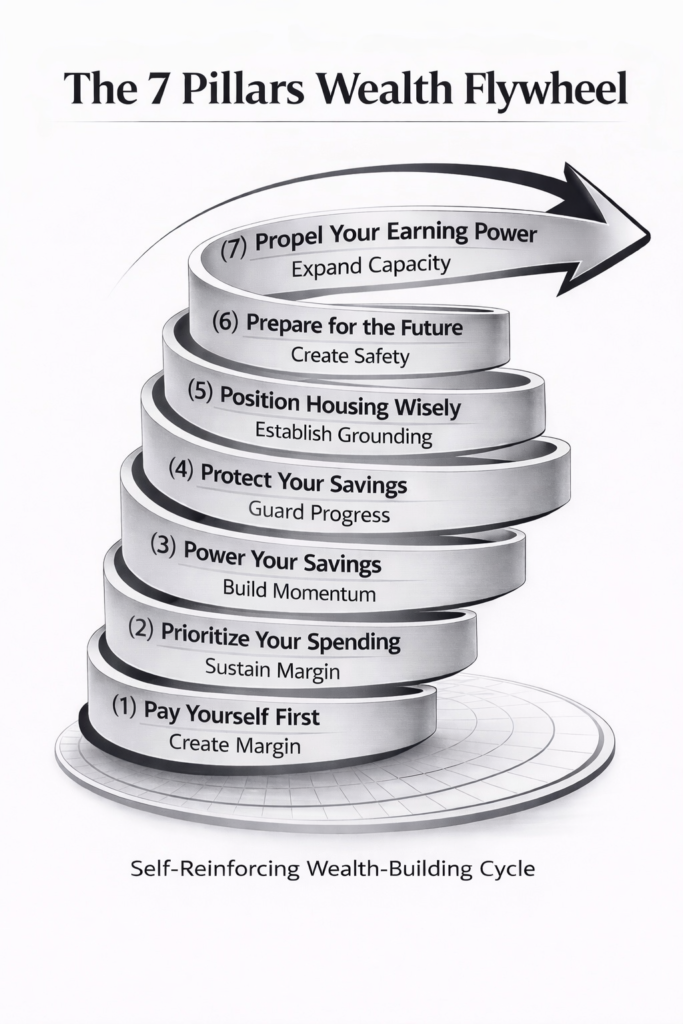
I think of this as a wealth flywheel. Over time, this flywheel builds momentum, not through intensity, but through consistency.
The goal of the Seven Pillars is not only to grow money. It is to protect the time and energy that make wealth meaningful.
Because wealth is not built through isolated decisions. It grows through structure that supports progress over time.
In the essays ahead, we will explore each pillar, one at a time.
Starting with the simplest and most overlooked piece.
How to create margin.
If this resonated, feel free to forward it to someone who might need it.
Enjoy essays like this? Join the newsletter.